When AVs Meet Emergency Vehicles, the Problem Isn't Vision. It's Communication.




A HAAS Alert Perspective
On July 8, NHTSA Administrator Jonathan Morrison sent a letter to every driverless vehicle developer in the country that was impossible to misread: "An automated vehicle that cannot safely interact with first responders is a danger to the general public." The agency laid out a documented pattern of AVs driving into active emergency scenes, blocking ambulances and fire apparatus, and failing to recognize flashing lights, flares, smoke, and cones, the same visual cues a licensed human driver is trained, tested, and legally obligated to yield to. Developers have been summoned to the table by month's end to show their work. As automotive industry analyst Roger Lanctot put it days later, robotaxis have become "the canary in the coal mine," exposing a shortcoming that runs deeper than any one company's sensor stack. It is a rare moment when a federal regulator, a fleet of billion-dollar technology companies, and the police officers and paramedics working the shoulder of the highway are all staring at the same unresolved question at once: how does a car with no driver know, in real time, that it is approaching a scene where lives are on the line?
The Challenge
That question deserves an honest answer, not a side to take. As Lanctot's analysis makes clear, this is not a story of careless developers ignoring an obvious fix. Robotaxi operators have spent years building an ad hoc patchwork of solutions, pull-over responses to flashing lights, audio detection of sirens, company-specific hand signals for officers on scene, vehicle orientation sessions to teach first responders where the kill switches and hard drives are. None of it has converged into something reliable, and none of it scales: with roughly 29,000 fire departments, nearly 18,000 law enforcement agencies, and upward of 15,000 EMS agencies operating across the country, no robotaxi operator can realistically train every jurisdiction on its own proprietary gestures and procedures, and no jurisdiction can realistically learn a different protocol for every vendor on its roads. NHTSA is right to insist that emergency scenes are not "edge cases." But the deeper diagnosis, the one regulators and developers alike have been slower to reach, is that this was never solvable as a per-company engineering problem. What's needed is a standardized, real-time channel connecting the status of an active emergency vehicle to the decision-making systems of every autonomous one nearby, the same channel, working the same way, everywhere.
The Solution: Safety Cloud®
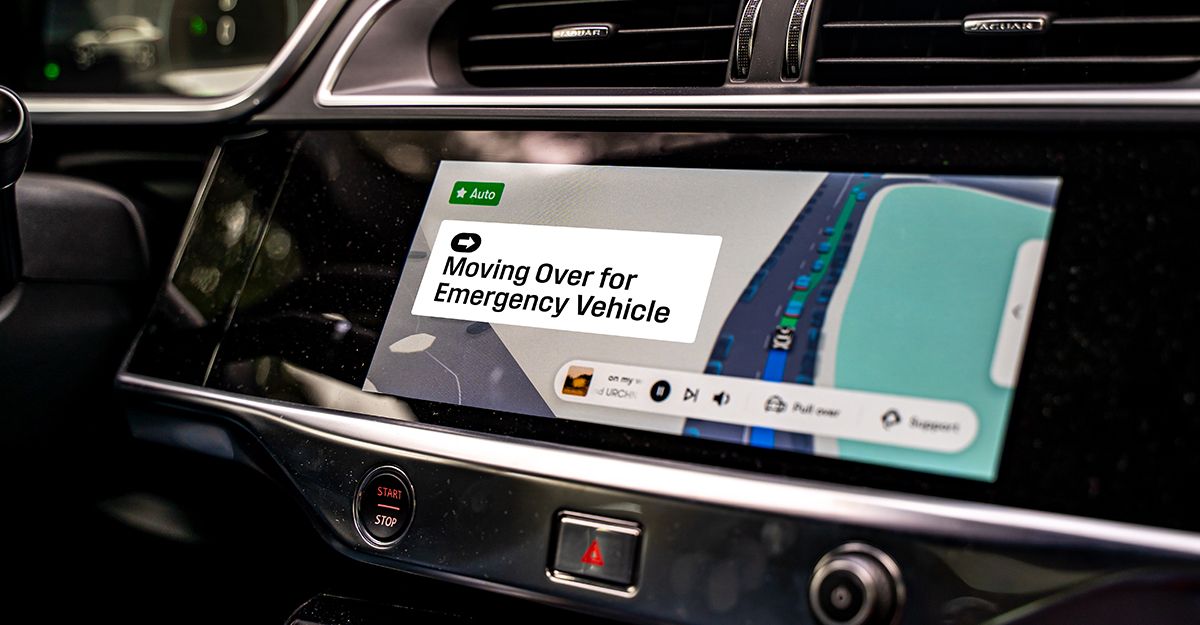
That channel already exists. HAAS Alert's Safety Cloud platform sends automatic, real-time digital alerts the moment a fire truck, ambulance, or squad car activates its lights, reaching connected vehicles, navigation apps, and driver dashboards before a human driver would otherwise see anything at all. It works today across thousands of fire, EMS, police, and DOT agencies nationwide and without asking any vehicle manufacturer to build a bespoke integration for every department it might one day encounter. That same proven, standardized infrastructure extends directly into the autonomous stack: a low-latency, machine-readable signal that tells an AV precisely what its cameras and microphones must be instructed to infer, that an emergency vehicle is active, where it is, and how it is behaving, well before line of sight, weather, smoke, or a chaotic scene would ever let a sensor catch up. Safety Cloud is the universal communication platform the AV industry needs, already built and already operating at the scale the problem demands.
The benefit of Safety Cloud is multi-fold. AV developers get a standardized way to demonstrate exactly the kind of good-faith progress NHTSA is demanding, without needing to solve a scalability problem that cannot be solved company by company, agency by agency. Regulators get an auditable, data-backed mechanism they can point to as evidence that developers are converging on a real solution rather than a patchwork of one-off workarounds. And the tens of thousands of fire departments, police agencies, and EMS providers on our roads get what they have wanted all along: one consistent, dependable signal that works the same way regardless of which company built the vehicle rolling toward their scene. Nobody has to lose for this to work. That is the entire point.
Connect & Protect… Today
So here is a direct, practical proposal for both sides of this table. To AV developers facing NHTSA's deadline: connect your fleets to Safety Cloud. It is not a multi-year integration or a proprietary protocol to reverse-engineer city by city, it is the same standardized data connection thousands of public safety agencies already broadcast into today, which means the moment you're connected, you're receiving real-time status on every one of those emergency vehicles, everywhere they operate. To the cities, fire departments, police agencies, and EMS providers watching this debate from the roadside: connect your emergency vehicles to Safety Cloud, if you haven't already, so your lights, your location, and your status are visible not just to distracted human drivers but to every AV built by every manufacturer that has made the same connection. Neither side needs to wait for the other to move first, and neither needs a custom solution built just for them. This is how "talking to each other" stops being an aspiration and becomes something that simply works, the same way, for every vehicle and every agency on the road.
Connected, Collision-Free Cities
NHTSA has given the industry a deadline and a mandate; it has not, and should not have to, hand developers a blueprint. That blueprint already exists, tested for years in the very use case at the center of this controversy, keeping emergency responders safe from vehicles that don't see them coming. When AV developers, cities, and public safety leaders sit down at the same table, the conversation should center less on whose fault this is and more on which infrastructure already works at the scale this problem requires. We believe Safety Cloud is the best opportunity for AVs and emergency vehicles to share the road safely and securely, not because it favors one side of this debate, but because it gives every side the same real-time truth to act on.