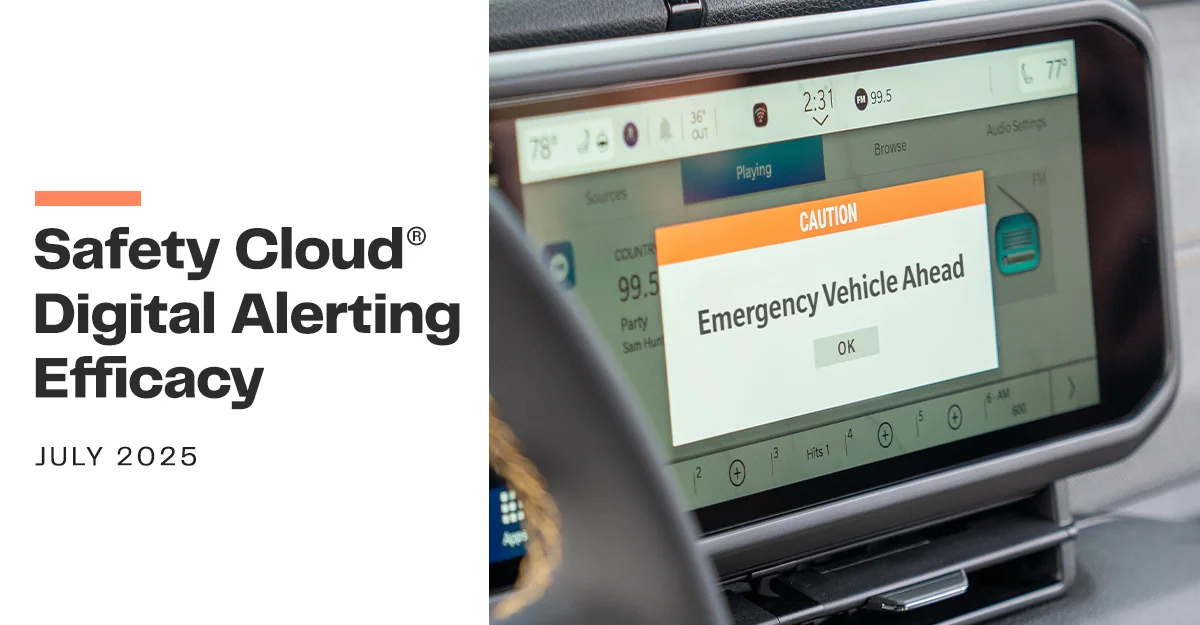
A February 2026 field study from the University of Illinois and the Illinois Center for Transportation (FHWA-ICT-26-003) measured exactly what changes when drivers receive in-vehicle digital alerts before they ever see a flashing light.
Researchers conducted two real-world experiments on Illinois freeways, capturing roughly 10 hours of aerial footage from a helicopter at 1,000 feet. From that footage, they extracted vehicle speed, lane position, and lane-change timing across thousands of vehicles to compare the behavioral impact of digital alerting to normal emergency and warning lights.
The study also evaluated compliance with Illinois' Move Over law (Scott's Law), enacted in 2002 following the death of Chicago Firefighter Lt. Scott Gillen. Digital alerts measurably improved how drivers approached stationary scenes before any visual cue was present.
DOWNLOAD THE REPORT




Download now
Welcome back!
Get your copy of
University of Illinois Study: Digital Alerts Cut Speed Variability 43%, Extend Reaction Distance 4x
Success! Click here to download
download nowUniversity of Illinois Study: Digital Alerts Cut Speed Variability 43%, Extend Reaction Distance 4x
University of Illinois Study: Digital Alerts Cut Speed Variability 43%, Extend Reaction Distance 4x
A February 2026 field study from the University of Illinois and the Illinois Center for Transportation (FHWA-ICT-26-003) measured exactly what changes when drivers receive in-vehicle digital alerts before they ever see a flashing light.
Researchers conducted two real-world experiments on Illinois freeways, capturing roughly 10 hours of aerial footage from a helicopter at 1,000 feet. From that footage, they extracted vehicle speed, lane position, and lane-change timing across thousands of vehicles to compare the behavioral impact of digital alerting to normal emergency and warning lights.
The study also evaluated compliance with Illinois' Move Over law (Scott's Law), enacted in 2002 following the death of Chicago Firefighter Lt. Scott Gillen. Digital alerts measurably improved how drivers approached stationary scenes before any visual cue was present.